You already know something is off in those conversations.
Most manipulation doesn't look like manipulation.
It looks like a question. A favor. A tone. A silence. Close the Opening maps the 27 psychological tactics people use in everyday conversations — and shows you where the pressure actually enters.
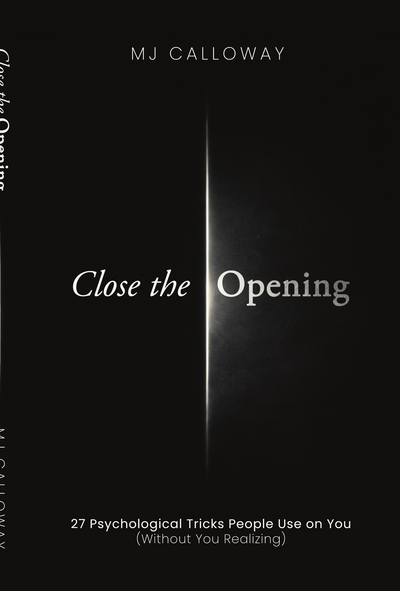
Close the Opening is a psychological framework and nonfiction book by MJ Calloway. It identifies 7 Entry Points — the specific places where social pressure enters everyday conversations — and maps the 27 tactics people use to exploit them.
Does this sound familiar
You said yes before you finished processing the question.
You explained yourself a third time — even though nothing was unclear.
You felt the tension building and backed down. Not because you agreed.
They described the problem in just the right way — and now it's yours.
You replayed the conversation for hours, trying to find where it turned.
You did the right thing. It still felt like you lost.
If you've felt any of these — you already have an entry point. You just haven't named it yet.
How it works
Pressure doesn't force its way in. It finds an opening.
Every person has a specific place where social pressure enters their conversations. A default reaction they don't notice. A pattern that other people learn to use — consciously or not.
This framework calls that place your Entry Point.
Identify the opening
Where pressure gets in. The reaction pattern you've had your entire life but never named.
See it while it's happening
Not after. Not in the shower replaying it. In the actual moment the tactic is being used.
Close it without losing ground
Without over-explaining. Without fixing it for them. Without retreating to keep the peace.
Entry Point
Where pressure gets in
Recognize
See it while it happens
Respond
Without losing ground
Close It
Pattern ends cleanly
The 7 Entry Points
Everyone has one. Most people have never named theirs.
Pressure doesn't enter randomly. It enters through the same place every time. These are the seven most common openings.
"But why though? I just don't understand your reasoning."
You re-explain until you doubt your own position. They didn't misunderstand. They learned that questioning your logic keeps you talking until you give ground.
"Wow, I didn't expect you to say no to that."
You said yes before you finished processing the question. The thought of someone thinking you're selfish is worse than whatever you just agreed to.
"I just don't know what to do about this whole situation."
They described the problem in just the right way — and now it's yours. Two hours later, you're solving something that was never your responsibility.
"I mean, I just wasn't sure you could handle it."
You should have said "I'm choosing not to." Instead you said "Watch me." Now you're three weeks into something you never wanted — to prove a point no one's tracking.
"Fine. I guess we just won't talk about it then."
The tension was building so you backed down. Not because you agreed — because the discomfort of continuing felt worse than giving in.
"After everything we've been through together."
That sentence has kept you in places you should've left years ago. The relationship changed. You're still honoring a version that no longer exists.
"Trust me, I've seen this before. You're overthinking it."
They said it with such certainty that you assumed they knew something you didn't. You deferred. Later you realized your read was right all along.
28 questions · 4 minutes · Free · Results are immediate
Recognition is only the beginning. The full framework is explored in Close the Opening.
The Book
Close the Opening
27 Psychological Tricks People Use on You (Without You Realizing)
A field guide to the pressure tactics hiding inside everyday conversations. Each of the 27 tactics is broken down the same way: what it sounds like, why it works on you specifically, and a clean response that ends it without escalation.
Sample tactics from the book
Entry Point Assessment
Identify where pressure enters your conversations.
This is not a personality quiz. It's a diagnostic tool. Your results map the specific opening that social pressure uses on you — and which of the 27 tactics are most likely to work.
No account required. Results are immediate.
Once you see the opening, you can't unsee it. And once you can't unsee it, it stops working.
The pattern runs until you name it.
Find Your Entry Point